

I just got back from the AI & Copilot Summit in San Diego, and my brain is still buzzing in that very specific “I need to take apart a toaster just to understand something better” way. Spending a few days surrounded by people building, experimenting, and pushing on the edges of what AI can do made it impossible not to come home with a head full of ideas—and this post is one of them.
There’s a weird myth floating around right now that AI is basically a giant cost‑cutting Roomba that rolls into your org, vacuums up jobs, and leaves behind a shiny, efficient future.
That’s… not how any of this works.
If you’ve ever built anything real — a circuit, a game mechanic, a Business Central extension, a D&D campaign, whatever — you already know the truth:
You can only cut so much. But you can build forever.
And that’s the real story of AI.
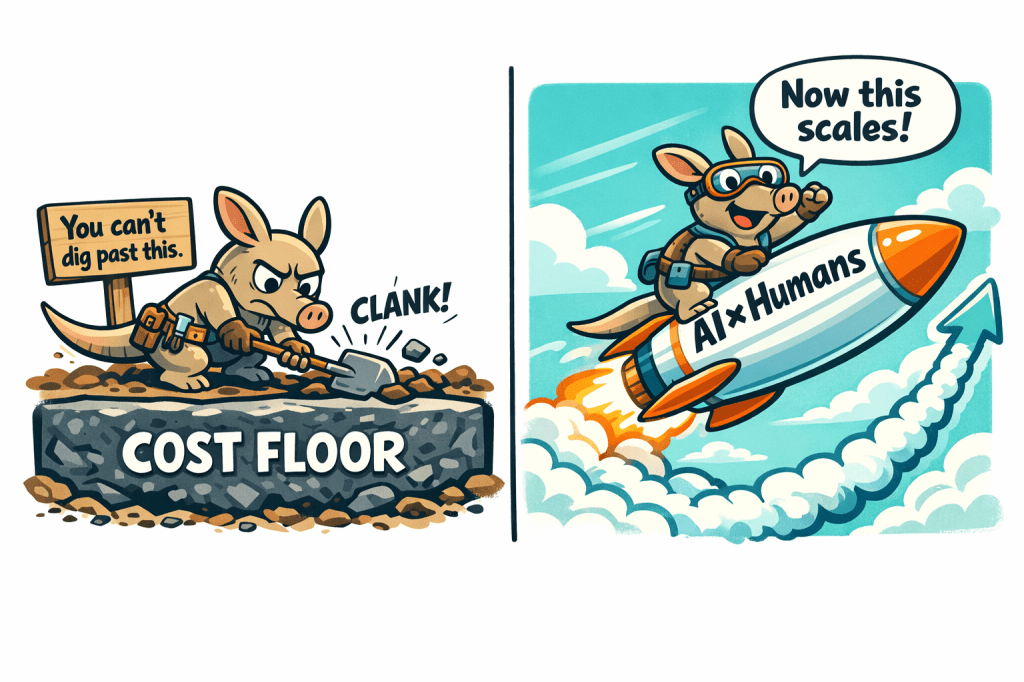
Cost Cutting Has a Floor (and You Hit It Fast)
Every system — whether it’s a company, an event, or a project in your home workshop — has a minimum viable cost. There’s always some combination of:
- infrastructure
- maintenance
- oversight
- debugging
- human judgment
- “don’t burn the house down” safety checks
You can optimize these, sure. You can automate the boring parts. You can make the whole thing smoother.
But you can’t cost‑cut your way to greatness.
At some point, you hit the floor. And after that, every extra “efficiency” gain feels like shaving microns off a 3D printed model. Technically possible, practically pointless.
Productivity, On the Other Hand, Doesn’t Have a Ceiling
This is where things get fun.
When you give your team AI — not as a replacement, but as a power tool — you stop playing the subtraction game and start playing the multiplication game.
AI lets people:
- explore 20 ideas instead of 2
- generate prototypes in minutes
- test scenarios that used to require entire teams
- automate the glue work that slows everything down
- run parallel workflows like a tiny digital factory
It’s like handing every person a swarm of tireless little helpers who don’t mind doing the repetitive stuff so humans can stay in the creative, strategic, “let’s make something awesome” zone.
And when humans stay in the loop — steering, correcting, imagining — the output curve stops looking linear and starts looking… well, kind of ridiculous.
I’m a huge fan of the “fail fast prototype”. You research until the tipping point where the time to build a prototype is less than or equal to the time to research if that prototype would work. Here we switch from researching to building.
The best case is you have a working prototype and the project moves forward; the worst you learned something new but didn’t lose any time. AI lets me create a prototype so much faster; therefore, I can explore more concepts in the same amount of time. The time between research and results gets smaller, therefore I produce more results.
That’s the unbounded side of the equation.
The Teams That Win Aren’t Smaller — They’re Supercharged
Look around at the teams doing the coolest work right now:
- Designers who iterate like they’re speedrunning creativity
- Developers who ship features before the coffee cools
- Analysts who model entire universes of “what if”
- Writers who produce polished drafts at the speed of thought
- Makers who prototype hardware with AI as their lab partner
These aren’t stories of AI replacing people. They’re stories of AI amplifying people.
A team of 10 with AI can outperform a team of 100 without it. But a team of 10 with AI and the right 90 humans?
That’s where you get breakthroughs. That’s where you get new products, new markets, new ideas. That’s where you get the kind of growth curves that make economists squint.
The Future Isn’t “AI Instead of Humans.” It’s “AI × Humans.”
If you use AI to shrink your team, you’ll hit the cost floor and stall out.
If you use AI to expand what your team can do, you tap into the unbounded side of the curve — the side where creativity, innovation, and output scale in ways that feel almost unfair.
So the real strategic question isn’t:
“How many people can AI replace?”
It’s:
“How much more could our people build with AI at their side?”
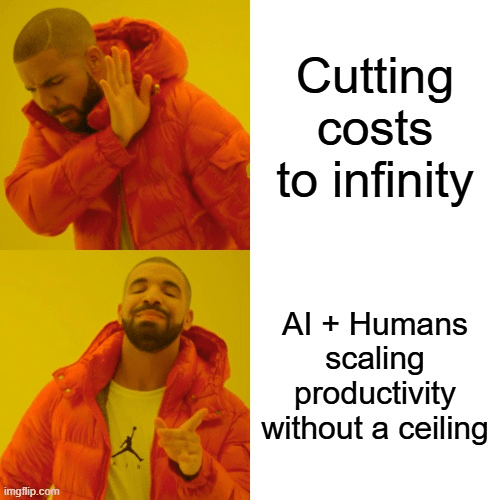
Because the companies that treat AI as a replacement tool will get incremental gains. The companies that treat AI as a force multiplier will get exponential ones.
Closing Thoughts
I don’t usually lean on AI when I’m writing for AardvarkLabs. Most of the time it’s just me, a keyboard, and whatever idea has been rattling around in my head long enough that it demands to be built, tested, or written down.
But this topic—bounded cost‑cutting vs unbounded productivity—deserved a deeper dive, and a different kind of research, than my usual solo sprint. So, for this post, I experimented with something new: I used Copilot as a research partner and drafting assistant. Not to replace my voice, but to amplify it. I’m a code monkey not a business major, I need help to chase down sources faster, pressure‑test my assumptions, and help shape the structure around the ideas I already wanted to explore.
When I started this article, I had a completely different set of assumptions. As opposed to agreeing with me, Copilot provided me with links to research articles that helped me understand what I was seeing and frame my experiences in a way that matched what the research was showing. Confirmation bias with AI is something we have to watch out for, and I’m excited that in this case I experienced the opposite.
If anything, the experience reinforced the whole point of the article: AI doesn’t diminish the human part of the work—it expands what’s possible when you stay in the loop.
Thanks for reading, and for building cool things alongside me.
Additional Reading
MIT/Sloan – AI is more likely to complement, not replace, human workers. https://mitsloan.mit.edu/press/new-mit-sloan-research-suggests-ai-more-likely-to-complement-not-replace-human-workers New MIT Sloan research suggests that AI is more likely to complement, not replace, human workers.
AI Agents vs Human Teams https://axis-intelligence.com/ai-agents-vs-human-teams-productivity/ After analyzing productivity data from over 100,000 workers across 15 groundbreaking studies, we’ve uncovered a productivity paradox: while AI agents can replicate the output of entire human teams in specific tasks, the highest performance comes not from replacement, but from strategic collaboration. Organizations implementing optimal human-AI partnerships report 60-81% higher productivity gains than those pursuing pure automation strategies.
MIT / Stanford – Generative AI Enhances Worker Productivity https://economics.mit.edu/sites/default/files/inline-files/Noy_Zhang_1.pdf A landmark study showing 14–35% productivity gains for customer support workers using AI tools, with the biggest improvements for less‑experienced workers.
GitHub – The Developer Productivity Report https://github.blog/news-insights/research/the-economic-impact-of-the-ai-powered-developer-lifecycle-and-lessons-from-github-copilot/ Discusses the costs associated with the implementation of agenic AI.
Balancing cost and performance: Agentic AI development https://www.datarobot.com/blog/cut-agentic-ai-development-costs/ Shows how AI coding assistants reduce cognitive load and increase developer satisfaction and throughput.
Deloitte – State of AI in the Enterprise https://www2.deloitte.com/us/en/insights/focus/cognitive-technologies/state-of-ai-and-intelligent-automation-in-business-survey.html Shows that governance, integration, and oversight remain non‑automatable and create a structural cost floor.
Baumol’s Cost Disease (Wikipedia overview) https://en.wikipedia.org/wiki/Baumol%27s_cost_disease Classic economic theory explaining why some tasks resist automation and maintain cost.
Erik Brynjolfsson – The Productivity J‑Curve https://www.aeaweb.org/articles?id=10.1257/jep.33.2.3 Explains why AI investments initially look slow but then unlock exponential returns once workflows adapt.
Anthropic – Constitutional AI https://www.academia.edu/129080466/Constitutional_AI_An_Expanded_Overview_of_Anthropics_Alignment_Approach Shows that human‑guided oversight produces safer, more aligned systems than fully automated training.



 Aardvark Labs
Leave a comment